

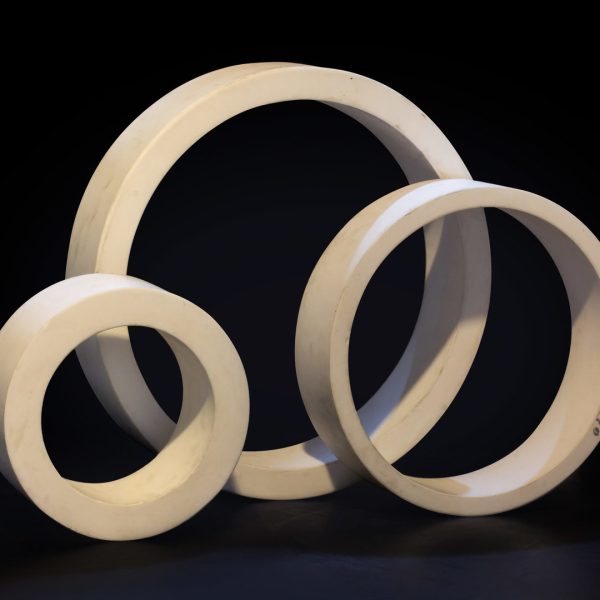
Glass Filled PTFE is a reinforced PTFE material containing glass fillers to improve compressive strength, wear resistance, and dimensional stability compared to virgin PTFE. It is widely used for CNC-machined parts, bushings, rings, seals, and components operating under load, pressure, and continuous motion in chemical, oil & gas, and industrial machinery applications.
What Is Glass Filled PTFE?
Glass Filled PTFE is a reinforced PTFE grade engineered by adding approximately
15% to 25% glass fillers to virgin PTFE. This modification significantly enhances
mechanical strength, wear resistance, compressive performance, and dimensional stability,
making it suitable for applications where pure PTFE is too soft or prone to creep.
The addition of glass fibers increases stiffness and load-bearing capacity while maintaining
PTFE’s key advantages, including low friction and broad chemical resistance.
Key Engineering Advantages
- Higher compressive strength: Improved load capacity compared to virgin PTFE.
- Excellent wear resistance: Suitable for continuous sliding and mechanical contact.
- Enhanced dimensional stability: Reduced deformation under pressure and temperature changes.
- Improved creep resistance: Better long-term performance under constant load.
- Machinable for CNC components: Suitable for precision-machined industrial parts.
- Wide service temperature range: Stable operation from approximately -200 to +260 °C.
- Good chemical resistance: Retains most PTFE chemical inertness with slight reduction.
Typical Industrial Applications
- Bushings and bearings operating under pressure
- Rings, seals, and industrial gaskets
- CNC-machined precision components
- Pumps, valves, and fluid handling equipment
- Industrial machinery with continuous motion
- Chemical, petrochemical, and oil & gas systems
Technical Properties of Glass Filled PTFE
| Property | Typical Value |
|---|---|
| Glass Content | 15% – 25% |
| Density | 2.16 – 2.23 g/cm³ |
| Shore D Hardness | 60 – 68 |
| Compressive Strength | Approximately 35 – 55 MPa |
| Creep Resistance | Significantly improved vs virgin PTFE |
| Coefficient of Friction | 0.09 – 0.12 |
| Service Temperature Range | -200 to +260 °C |
| Wear Resistance | Very high |
Glass Filled PTFE vs Other PTFE Grades
- Compared to virgin PTFE: Higher stiffness, better wear resistance, and improved load capacity.
- Compared to carbon filled PTFE: Greater hardness and dimensional stability, slightly higher friction.
- Compared to bronze filled PTFE: Better chemical resistance and lower density.
Frequently Asked Questions
When should glass filled PTFE be selected?
For applications involving high pressure, continuous motion, wear, and dimensional stability requirements,
glass filled PTFE is an excellent choice.
Does glass filled PTFE maintain chemical resistance?
Yes. Most PTFE chemical resistance is retained, though it is slightly reduced compared to virgin PTFE.
It is not recommended for extremely aggressive acids.
What are the most common applications?
Bushings, bearings, rings, seals, pump components, valve parts, and CNC-machined industrial components
operating under load and wear.
What information is required for proper grade selection?
Operating pressure, temperature, type of motion, chemical exposure, and component dimensions are essential
for accurate material selection.